
Very brief, Sūrat al-Fātiḥa (literally “The Opening”) opens the Qur’an as a prayer addressed to Allāh, composed of praise, a plea for help, and a request to be guided on the “straight path.”
Recited daily in ritual prayer, it sets the tone of Qur’anic piety: exclusive worship, dependence on Allāh, and the horizon of Judgment. It immediately raises the central question the rest of the Qur’an will develop: what is the “straight path,” and how can it be recognized?
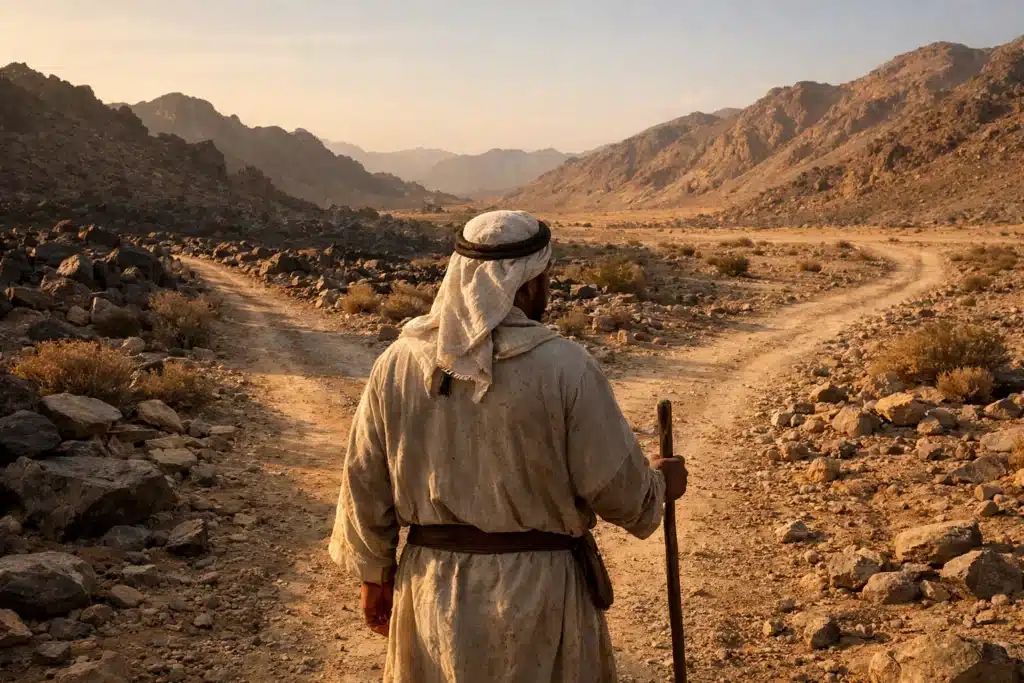
The surah al-Fātiḥa concludes with a single request: to be guided. After praise and the profession of worship, the prayer turns into supplication. The believer asks neither for wealth nor for material protection, but for direction in life.
The ṣirāṭ al-mustaqīm, the “straight path,” refers to an orientation that only God can grant. Human life thus appears as a journey in which one may advance in uprightness or become lost.
The verse finally clarifies this path by contrast: it is the path of those who have received Allah’s blessings, and not that of those who have incurred his wrath or have gone astray. The prayer therefore defines the desired way both by what it is and by what it is not.
The theme of the “straight path” runs throughout the Qur’an. It appears as the way that God sets before believers and which they are called to follow. Thus Allah declares: “This is my path in its straightness. Follow it, and do not follow other paths that would lead you away from his way” (S. 6:153). Uprightness is not merely a moral image: it refers to concrete fidelity to the divine will.
The Qur’an also specifies the identity of those who have received Allah’s blessings: “the prophets, the truthful, the martyrs, and the righteous” (S. 4:69). The path requested in the Fātiḥa is therefore that of a continuity of faithful believers throughout time.
By contrast, the Qur’an often mentions those who move away from this path: “Whomever Allah leads astray, none can guide” (S. 7:186), or those who “go far astray from the straight path” (S. 4:167). Error appears sometimes as a rejection of revealed truth and sometimes as a gradual deviation from the right way.
The prayer mentions three groups: those who have received blessings, those who have incurred wrath, and those who are astray. The surah itself does not explicitly name these groups, but other passages of the Qur’an have led Muslim commentators to propose identifications.
In several early exegetical traditions, “those who incurred wrath” have been associated with the Jews and “those who are astray” with the Christians. This interpretation, reported in particular by al-Ṭabarī, relies on various Qur’anic verses and has left a lasting mark on Islamic tradition1.
A tension therefore appears for the Christian reader. If Christians are counted among the “astray,” the straight path requested in this prayer is also defined in opposition to the Christian faith. The divergence thus concerns not only religious practices but the very understanding of revelation and of God.
The image of the path as a symbol of human life is very ancient in the biblical tradition. Psalm 1 contrasts the way of the righteous with that of the wicked: “The Lord knows the way of the righteous, but the way of the wicked will perish”2.
The wisdom books also use this image. The Book of Proverbs speaks of a path that grows brighter for the righteous3. Walking on the right way means living according to God’s will.
Jesus uses the same image when he speaks of the narrow gate: “Wide is the gate and broad the road that leads to destruction […] but narrow is the gate and constricted the road that leads to life”5. Early Christian catechesis would take up this contrast: the Didache begins with these words: “There are two ways: one of life and one of death”4.
The prayer asking God to guide human beings also appears in the Bible: “Lead me in your truth and teach me” (Ps 24[25]:5)6. In this way, the human person acknowledges that he cannot find the right path alone.
This first surah, al-Fātiḥa, appears in a context in which the new Muslim community gradually distinguishes itself from other religious traditions present in Arabia. Jewish and Christian groups were established in the region, while polytheistic cults remained widespread.
Asking not to follow the path of the “astray” thus participates in defining a new religious identity. The prayer draws a line between the path the community intends to follow and those it considers deviant.
In this context, the prayer also plays a role of religious demarcation. It expresses the desire to be counted among those who walk on the path approved by Allah and not among those who have turned away from it.
The request to be guided on the right path is profoundly just. It recognizes that human beings can go astray and need to be led by God.
Christianity answers this prayer in an unexpected way. Jesus does not merely say that he shows the way. He declares that he himself is “the Way, the Truth, and the Life”7. The path is no longer only a direction to follow but primarily a person to encounter.
From that point on, the prayer to be guided takes on a new meaning. To be led no longer means simply walking on a good road. It means being led by Christ and toward Christ, and entering into a living relationship with him.
The surah al-Fātiḥa concludes with a single request: to be guided. After praise and the profession of worship, the prayer turns into supplication. The believer asks neither for wealth nor for material protection, but for direction in life.
The ṣirāṭ al-mustaqīm, the “straight path,” refers to an orientation that only God can grant. Human life thus appears as a journey in which one may advance in uprightness or become lost.
The verse finally clarifies this path by contrast: it is the path of those who have received Allah’s blessings, and not that of those who have incurred his wrath or have gone astray. The prayer therefore defines the desired way both by what it is and by what it is not.
The theme of the “straight path” runs throughout the Qur’an. It appears as the way that God sets before believers and which they are called to follow. Thus Allah declares: “This is my path in its straightness. Follow it, and do not follow other paths that would lead you away from his way” (S. 6:153). Uprightness is not merely a moral image: it refers to concrete fidelity to the divine will.
The Qur’an also specifies the identity of those who have received Allah’s blessings: “the prophets, the truthful, the martyrs, and the righteous” (S. 4:69). The path requested in the Fātiḥa is therefore that of a continuity of faithful believers throughout time.
By contrast, the Qur’an often mentions those who move away from this path: “Whomever Allah leads astray, none can guide” (S. 7:186), or those who “go far astray from the straight path” (S. 4:167). Error appears sometimes as a rejection of revealed truth and sometimes as a gradual deviation from the right way.
The prayer mentions three groups: those who have received blessings, those who have incurred wrath, and those who are astray. The surah itself does not explicitly name these groups, but other passages of the Qur’an have led Muslim commentators to propose identifications.
In several early exegetical traditions, “those who incurred wrath” have been associated with the Jews and “those who are astray” with the Christians. This interpretation, reported in particular by al-Ṭabarī, relies on various Qur’anic verses and has left a lasting mark on Islamic tradition1.
A tension therefore appears for the Christian reader. If Christians are counted among the “astray,” the straight path requested in this prayer is also defined in opposition to the Christian faith. The divergence thus concerns not only religious practices but the very understanding of revelation and of God.
The image of the path as a symbol of human life is very ancient in the biblical tradition. Psalm 1 contrasts the way of the righteous with that of the wicked: “The Lord knows the way of the righteous, but the way of the wicked will perish”2.
The wisdom books also use this image. The Book of Proverbs speaks of a path that grows brighter for the righteous3. Walking on the right way means living according to God’s will.
Jesus uses the same image when he speaks of the narrow gate: “Wide is the gate and broad the road that leads to destruction […] but narrow is the gate and constricted the road that leads to life”5. Early Christian catechesis would take up this contrast: the Didache begins with these words: “There are two ways: one of life and one of death”4.
The prayer asking God to guide human beings also appears in the Bible: “Lead me in your truth and teach me” (Ps 24[25]:5)6. In this way, the human person acknowledges that he cannot find the right path alone.
This first surah, al-Fātiḥa, appears in a context in which the new Muslim community gradually distinguishes itself from other religious traditions present in Arabia. Jewish and Christian groups were established in the region, while polytheistic cults remained widespread.
Asking not to follow the path of the “astray” thus participates in defining a new religious identity. The prayer draws a line between the path the community intends to follow and those it considers deviant.
In this context, the prayer also plays a role of religious demarcation. It expresses the desire to be counted among those who walk on the path approved by Allah and not among those who have turned away from it.
The request to be guided on the right path is profoundly just. It recognizes that human beings can go astray and need to be led by God.
Christianity answers this prayer in an unexpected way. Jesus does not merely say that he shows the way. He declares that he himself is “the Way, the Truth, and the Life”7. The path is no longer only a direction to follow but primarily a person to encounter.
From that point on, the prayer to be guided takes on a new meaning. To be led no longer means simply walking on a good road. It means being led by Christ and toward Christ, and entering into a living relationship with him.
1 Al-Ṭabarī, Jāmiʿ al-bayān ʿan taʾwīl āy al-Qurʾān, commentary on S. 1:7: several early traditions identify “those who incurred wrath” with the Jews and “those who are astray” with the Christians.
2 Psalm 1:6 : “The Lord knows the way of the righteous, but the way of the wicked will perish.”
3 Proverbs 4:18 : “The path of the righteous is like the light of dawn, which shines brighter and brighter until full day.”
4 Didache 1:1 : “There are two ways: one of life and one of death; and there is a great difference between these two ways.”
5 Matthew 7:13–14 : “Broad is the road that leads to destruction […] narrow the road that leads to life.”
6 Psalm 24 [25]:5 : “Lead me in your truth and teach me.”
7 John 14:6 : “I am the Way, the Truth, and the Life.”